Why your global data strategy is about to become illegal.
Sovereign AI
The era of the “Open Internet” is ending. As nations rush to build “Sovereign AI,” they are erecting digital borders that prevent data from leaving their soil. For global impact organizations, the model of centralized cloud storage is becoming a liability. The Directive: Treat data compliance as a geopolitical risk, not an IT ticket. That being said we all know its still a dark world when it comes to access to necessary data for specific social impact led orgs . Data hoarding is an issue and the speed at which data is collected and shared is super slow . What then? The concept of the “Open Internet” is fading as nations prioritize “Sovereign AI” and establish digital boundaries to keep data within their borders. For global impact organizations, this shift makes relying on centralized cloud storage a significant liability.
Data compliance must be addressed as a geopolitical risk, not merely an IT issue.
However, a serious challenge remains for social impact organizations: the necessary data environment is still underdeveloped. Data hoarding and the extremely slow pace of data collection and sharing persist. What is the path forward in this landscape?
The Sovereign AI Iron Curtain
For the past decade, the operational model employed by global non-profits and NGOs was straightforward: data collection occurred in the field (Global South), storage was maintained in the cloud (AWS/Azure/Google), and analysis was conducted at the headquarters (Global North).
This model is now demonstrably collapsing.
We are observing the rapid fragmentation, or “balkanization,” of the internet. While its inception can be traced to GDPR in Europe, the significant acceleration is presently occurring across the Global South (including nations such as India, Brazil, Indonesia, Nigeria, Kenya, and South Africa). These nations no longer regard data merely as “user information”; instead, they treat it as a critical national asset, indispensable for training their own AI models and safeguarding national interests.
The “Data Colonialism” Rebuttal
Governments have recognized that permitting Western NGOs and technology corporations to harvest local data and export it to US-based servers effectively constitutes an exportation of their future Gross Domestic Product.
If an AI model is trained utilizing Nigerian health data, Nigeria asserts that ownership of that model should be Nigerian, or at a minimum, the model should reside on Nigerian servers. This concept is being termed “Sovereign AI.”

Consider the predicament of a scientist in a laboratory training AI models on data concerning malaria infections across Lagos, yet required to access that essential data through a foreign server. Such a system presents significant inefficiencies and risks.
The consequence is a complex tapestry of “Data Localization” laws, rendering the cross-border transfer of beneficiary data increasingly difficult—and in certain instances, legally prohibited.
The Strategic Perspective
The “Silicon Valley Stack” can no longer be considered geopolitically neutral. The utilization of standard US-based cloud tools in non-aligned countries now inherently involves geopolitical risk. Furthermore, the persistent display of cookie notifications across numerous browsing sessions underscores ongoing public and regulatory concern.
Should your organization measure impact by aggregating worldwide data into a single operational dashboard situated in New York or London, your comprehensive visibility is imminently threatened. The “Iron Curtain” of the 20th century impeded the movement of people; the Iron Curtain of 2026 impedes the movement of data.
The Directive
Instruct your Chief Information Officer (CIO) to execute a comprehensive Sovereignty Audit. Identify every nation in which your organization operates that has pending data localization legislation. This may necessitate a transition from a “Centralized Cloud” architecture to a “Federated” model, where data is retained locally, and only actionable insights are transmitted back to the central headquarters.
Appoint a dedicated data and AI champion; this measure is vital to ensuring the organization remains ahead of the curve and navigates the volatile AI environment effectively.
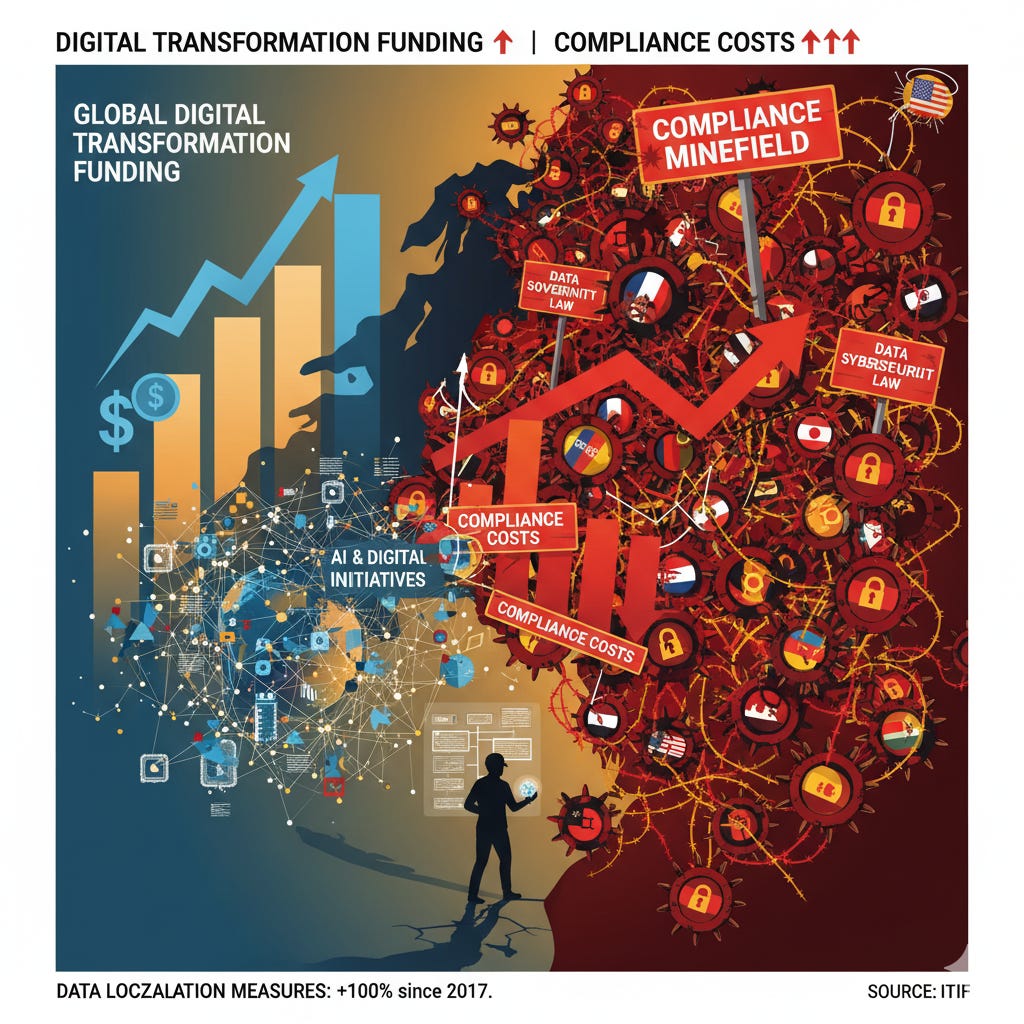
While global financial support for “Digital Transformation” has increased, the expense associated with regulatory compliance is escalating at a faster rate.
“The number of data localization measures in force globally has more than doubled in a period of just four years.”