Nonprofit Comms Don't Have a Creativity Problem. It Has a Capacity Problem.
Ask a nonprofit communicator what went wrong in 2025, and you won’t hear “we ran out of ideas.”
That’s the quiet headline buried in the 2026 Nonprofit Communications Trends Report. When it asked communicators to name their biggest challenges from the past year, the top answers weren’t about messaging, storytelling, or audience engagement. They were about capacity, structure, and sustainability.
Not creativity. Capacity.
A strain with no single cause
The report describes it as “a persistent strain that goes beyond any single task or channel.” That phrase is worth sitting with. It’s not one campaign that went sideways, one channel that underperformed, one launch that got botched under pressure. It’s the whole function asked, quietly and repeatedly, to do more than it can actually hold.
You can see the shape of it in what came next. When the same communicators were asked what they were looking forward to in 2026, the answers weren’t about better content or bigger ideas either. They were about how they work, not what they produce:
More sustainable workflows
Clearer roles
The chance to finish something instead of living in permanent reactive mode, bouncing from ask to ask
Read those two sets of answers side by side and the diagnosis writes itself. This isn’t a team short on imagination. It’s a team that hasn’t had the infrastructure to use the imagination it has.
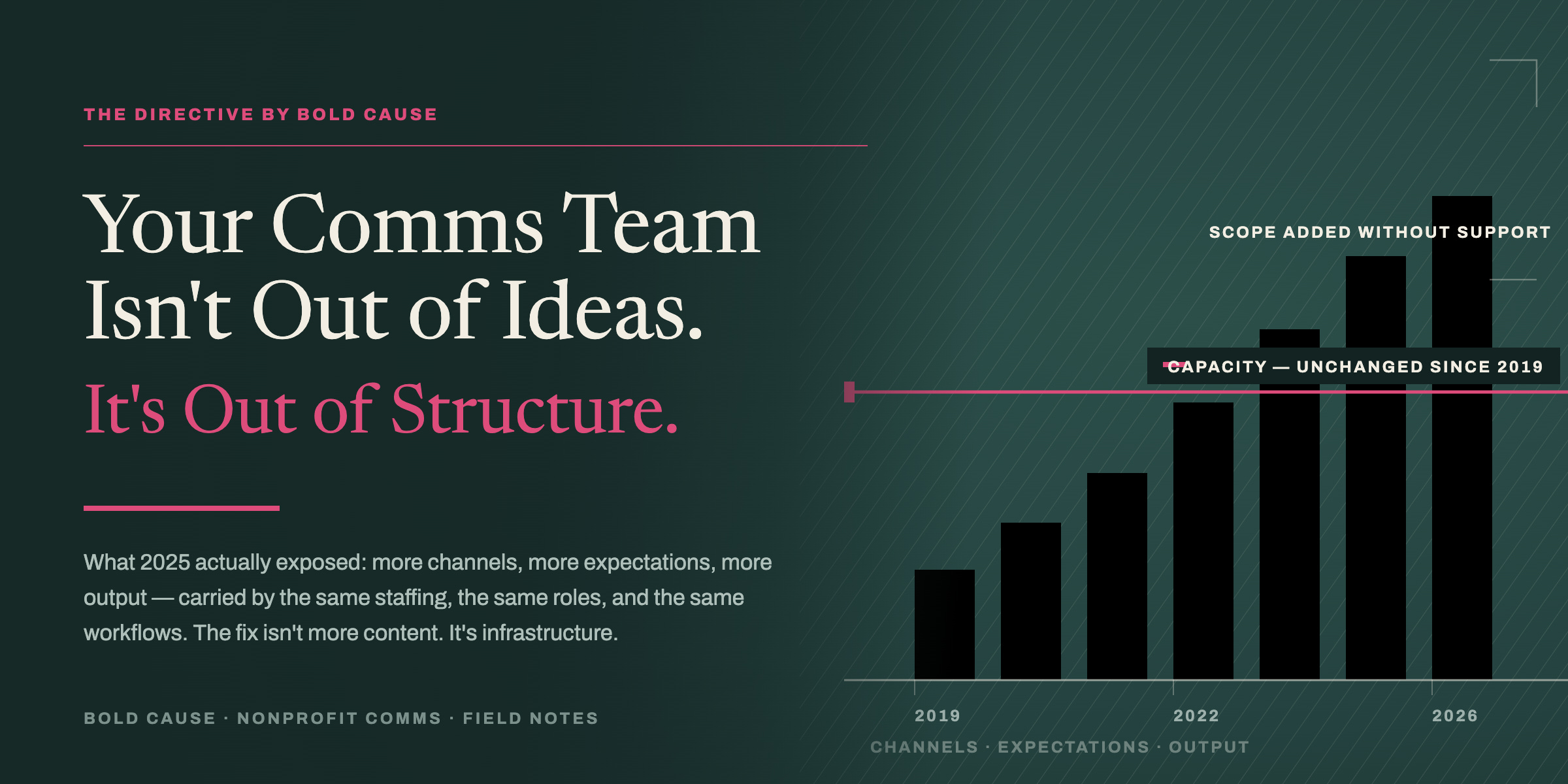
Scope grew. Structure didn’t.
Here’s the underlying pattern: nonprofit comms functions have expanded in scope without expanding in infrastructure.
More channels to manage. Higher expectations for what those channels should produce more frequent, more polished, more “on-brand,” more everything. And underneath all of it, the same structural conditions as before: the same headcount, the same unclear ownership, the same absence of a system for deciding what actually gets made and why.
The result isn’t hard to spot once you’re looking for it: communications that fills channels without being strategic, coherent, or sustainable. Content that exists because the calendar demanded something, not because it was the right thing to say, to whom, at that moment. A team producing constantly and still feeling like it’s falling behind because volume was never the actual goal.
The good news: this is a solvable problem
Here’s what matters most in the report’s findings these are structural problems, and structural problems are solvable. That’s genuinely good news, because it means the fix isn’t “hire more creative people” or “find a better content calendar template.” It’s not a talent gap or a tools gap.
It’s an infrastructure gap. And infrastructure can be rebuilt.
But rebuilding it requires a different conversation than the one most organizations are currently having. Most conversations about nonprofit comms still start with outputs: What are we posting? What’s the campaign? What’s the ask? Those are downstream questions. The upstream question — the one the data says actually needs answering — is about the system itself: How is this function structured? Who owns what? What does a sustainable workflow actually look like here, given our size and our resources? What are we choosing not to do, so that what we do keep can be done well?
That’s a harder conversation. It’s also the one that actually changes 2026 instead of just re-running 2025 with better intentions.
What communicators can do now
You may not control your org’s headcount or reporting lines. But there are moves within reach that shift you from filling channels to doing work you’re actually proud of:
1. Audit your channels against your capacity, not the other way around. List every channel you’re “supposed” to show up on. Then be honest about what you can staff well versus what you’re maintaining out of habit or fear of falling behind. A smaller number of channels done with intention beats a full spread done thin.
2. Name an owner for every recurring output. Vague ownership is where “reactive mode” lives. If a newsletter, a social calendar, or a reporting deck doesn’t have one clear owner, it will keep landing on whoever has the least ability to say no. Fix the ownership before you fix the workflow.
3. Build in a no-list, not just a to-do list. Ask leadership to agree, in writing, on what comms will not do this quarter which asks get declined or deferred by default. This is the single fastest way to protect capacity, because it moves the “no” upstream, before it becomes your problem alone.
4. Protect a “finish” cycle. Reactive work will always try to eat planned work. Block real time a week, a sprint, a standing half-day where the team finishes one piece properly instead of starting five. Pride in the work comes from completion, not output volume.
5. Separate “urgent” from “important” at the intake point. Most burnout in comms comes from every request arriving with the same fake urgency. Create a simple intake process even a one-page form that forces requesters to state real deadlines and real stakes. It won’t stop every fire drill, but it will stop most manufactured ones.
6. Make the case for infrastructure using the data, not vibes. Leadership responds to evidence. Use findings like this report or your own team’s tracked hours, channel performance, and turnaround times to show that the constraint is structural, not a motivation or skills problem. That reframes the ask from “we need more support” to “here’s what the data shows and here’s what fixing it requires.”
7. Revisit “why” before “what,” even under deadline. When there’s no time to think, it’s tempting to default to whatever worked last time. Protect five minutes per project to ask what this piece is actually for and who it’s for. That’s often the difference between content that fills a slot and work you’d put in a portfolio.
None of these require a bigger budget. They require a different conversation the one the report says most organizations still aren’t having.
Want a clear-eyed look at where your own comms function is straining and where the fixable structural gaps are?
Bold Cause runs a free comms audit sprint built for exactly this. Book your slot today .