Authentic storytelling is a power question, not a craft question.
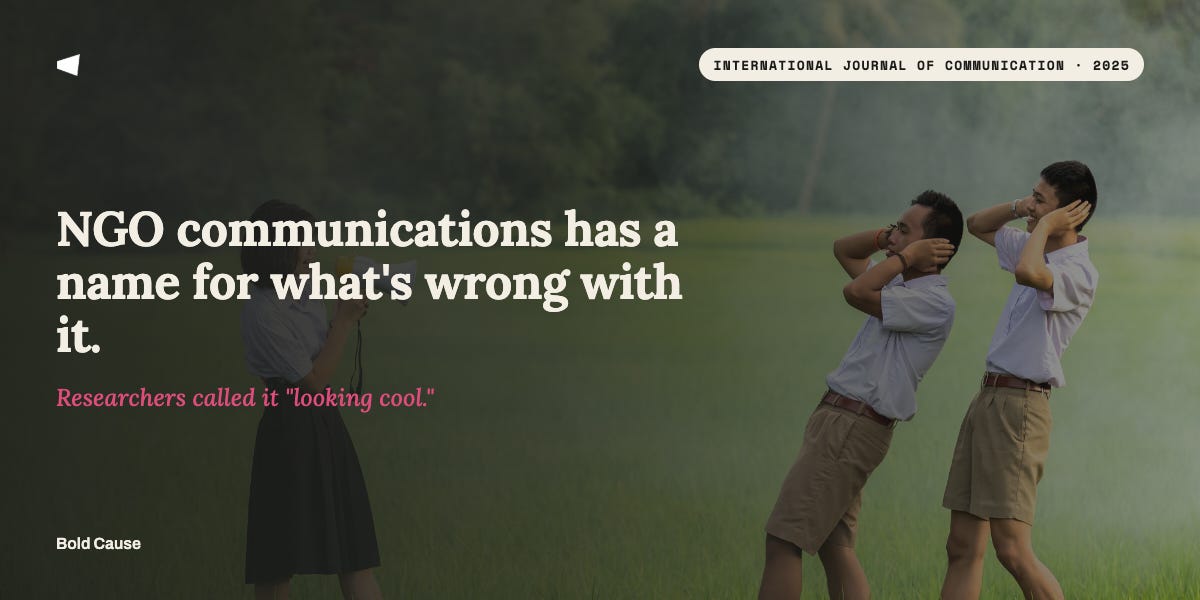
A study published earlier this year in the International Journal of Communication published earlier this year in the International Journal of Communication gave a precise name to something that practitioners in the sector have felt for a long time but rarely articulate directly.
Researcher Michael Dokyum Kim studied development NGOs and their social media communications. What he found wasn’t a failure of individual creativity or effort. It was structural.
The three pressures Kim identified
First: the pursuit of social media engagement metrics — likes, shares, reach — pushes organisations toward simplified, emotionally accessible content designed for northern audiences. The casualty is contextual complexity: the nuance that makes development work actually make sense gets stripped out in the service of content that travels.
Second: reputational risk aversion. NGOs are acutely sensitive to anything that might generate friction or controversy. The result is a consistent drift away from honest portrayals of difficulty, disagreement, or ambiguity — the very things that would make their communications feel real.
Third: intraorganisational incongruencies. Individual communicators who understand what’s wrong with the content they’re producing often find that the structures around them resist change. The problem isn’t knowledge. It’s architecture.
Kim called the result “looking cool” — a persistent tendency in NGO communications to optimise for emotional appeal and shareability rather than accuracy, accountability, or the perspectives of the communities the work is meant to serve.
Why the platform mechanics make this worse
The quantitative context helps explain why the structural pressure is so hard to resist. The average nonprofit reaches just 2.9% of its LinkedIn followers per post, with an average engagement rate of 1.91% (M+R Benchmarks / Global NGO Technology Report). Instagram organic reach dropped 12% year-on-year between 2024 and 2025 (Social Insider 2025). Across platforms, most nonprofits achieve organic reach of between 2–6% (GoodUnited / M+R Benchmarks).
When reach is this thin and algorithmic reward is this concentrated on content that generates immediate emotional engagement, “looking cool” isn’t just a cultural tendency. It’s the rational response to an irrational incentive structure.
Two frameworks practitioners are using in response
At the 2025 Nonprofit Storytelling Conference, Diana Farias Heinrich presented her EquaStory™ framework as a practical response to this problem. Her core distinction is between permission-based storytelling — where organisations obtain consent to tell someone’s story — and partnership-based storytelling, where communities have meaningful input into how the story is framed, what is included, what is omitted, and whether it gets shared at all.
Heinrich’s argument is that most organisations treat consent as the end of their ethical obligation. The EquaStory™ framework treats it as the beginning.
(nonprofitstorytellingconference.com/2025-sessions)
Trabian Shorters approaches the same problem from cognitive science. His asset-framing methodology — grounded in Nobel Prize-winning research by Daniel Kahneman on how framing shapes perception — argues that the way NGOs define communities in their communications determines how audiences understand those communities. When organisations default to deficit framing — describing communities primarily through their problems and vulnerabilities — they reinforce the very stigmas that make systemic change harder to achieve.
His January 2025 SSIR piece, “From Fixers to Builders,” now one of the top-3 most shared articles in Stanford Social Innovation Review history, makes the case for a shift in narrative identity: from organisations that solve problems to communities that are building something.
What this means for communications practice
The “looking cool” finding is uncomfortable precisely because it is structural. Individual communicators are not, in the main, unaware of the problem. They often know exactly what is wrong with the content they are producing. The issue is that the incentive architecture around them both within their organisations and within the platforms their organisations depend on consistently points in the wrong direction.
Changing that doesn’t start with better content. It starts with a different theory of what communications is for: not output to be produced, but a practice that shapes how an organisation understands and represents the work — and who gets to be part of that shaping.
That’s the conversation Bold Cause is built around.
---
If this is relevant to where your organisation is, book a discovery call — here.
*Sources: Kim, M.D. (2025), IJC Vol. 19 · Heinrich, D.F. (2025), EquaStory™, 2025 NSC · Shorters, T. (2025), SSIR · Platform data: M+R Benchmarks, Social Insider 2025, Nonprofit Tech for Good 2026*